
International Women's Day: Celebrating Ada Lovelace, the World's first computer programmer

Ada Lovelace had a challenged relationship with her father Lord Byron, but went on to do great things
On International Women's Day, we're celebrating the ladies who have made an impact on the world around us.


One notable historical female figure from Nottingham is Ada Lovelace, the world's first computer programmer.
Ada Lovelace made significant contributions to the field of mathematics and computing during the 19th century.
Born Augusta Ada Byron, she was the only legitimate child of the famous poet Lord Byron and mathematician Annabella Milbanke.
Ada showed an early aptitude for mathematics, influenced by her mother's determination to ensure that Ada did not follow in her father's footsteps, both literary and in terms of behaviour.
Annabella ended her marriage to Ada's father, Lord Byron when Ada was just a few months old. The marriage ended amid rumours of violence and incest.
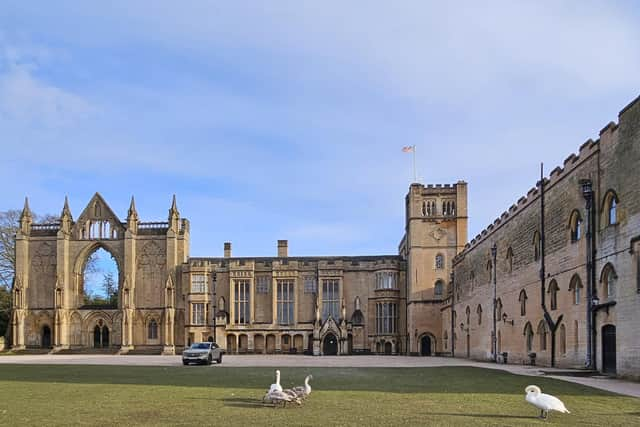
Lovelace visited the Byron family home of Newstead Abbey for the first and only time in 1850 as a guest of the new owner, Colonel Thomas Wildman, and felt conflicted and emotional about her stay there.
Conflicted between pride to see her father's legacy celebrated and a sense of sadness that it 'ought to belong to her'.
Despite a challenged relationship with her father, Ada went on to achieve many great things.
Ada Lovelace is best known for her work on Charles Babbage's Analytical Engine, an early mechanical general-purpose computer design.
Babbage conceived the Analytical Engine, and Ada Lovelace, with her deep understanding of mathematics and logic, translated an article on the engine by the Italian mathematician Luigi Federico Menabrea.
Her notes, which were more extensive than the original article, included an algorithm intended for the Analytical Engine to compute Bernoulli numbers.
This is considered by many as the first published algorithm intended for implementation on a machine, making Ada Lovelace the world's first computer programmer.
Although the Analytical Engine was never built during Ada's lifetime, her visionary insights into the potential of computing went beyond Babbage's ideas.
She recognised that such machines could go beyond mere calculation and be applied to any process that could be described by symbols and rules, foreshadowing the broader concept of a general-purpose computer.
An idol for women in STEM
Ada Lovelace's work laid the foundation for the development of modern computing, and her contributions have gained recognition and appreciation in the field of computer science.
The programming language "Ada" was named in her honour, and each year, Ada Lovelace Day is celebrated on October 9th to highlight the achievements of women in science, technology, engineering, and mathematics (STEM).
In 1852, Ada, Countess of Lovelace died and by her request, she was buried next to her father, Lord Byron (died, aged 36 in 1824) inside the Byron family vault in the Church of St. Mary Magdalene in Hucknall, Nottinghamshire.