
Nottingham worst of all major cities for homelessness - phone box becomes information point

Nottingham has the highest number of people sleeping rough out of all core cities.
A Nottingham phone box converted into a help and information point has become one of the ways the city is hoping to tackle “rising” rough sleeping and homelessness.

Government data shows that when compared to the size of the local population, Nottingham has the highest number of people sleeping rough out of all core cities.
The 12 core cities include Nottingham, Birmingham, Bristol, Cardiff, Edinburgh, Glasgow, Leeds, Liverpool, Manchester, Newcastle, Belfast and Sheffield.
According to Nottingham City Council, the number of longer-term rough sleepers “is high and rising”, with many individuals retracting from engaging with services and declining offers of accommodation.
Over recent years, the number of rough sleepers found on a single night count in Nottingham each month has varied between 40 to 60 people.
But figures show November was the worst month of the year, when 149 individuals were recorded as rough sleeping at some point during this period.
On top of rough sleeping, which is the most visible form of homelessness, around 130 households approach the council for homelessness help every week.
The number of single person households that came to the council in need of emergency accommodation has also “increased drastically in the last year”, rising from 339 cases in 2024 to 446 in 2025.
The council says it had a budget of £4.4 million for temporary accommodation in 2025 alone.
At a meeting on Monday (January 19), Debbie Richards, assistant director of Housing Solutions, said: “Our cases were, on average, 180 per officer.
The [Government] said case loads should be in the region of 35 to 40. So the average was four-and-a-half times what they needed to be.
“We have 6.2 per 1000 households are assessed as homeless; that is really high.”
Mark Lowe, the assistant director of the council’s housing services, added: “Our numbers are high. Most core cities have got a really high level of rough sleeping at the moment, it is a national problem.
“Our raw numbers are lower than most of the core cities, but as a proportion of population they are higher.”
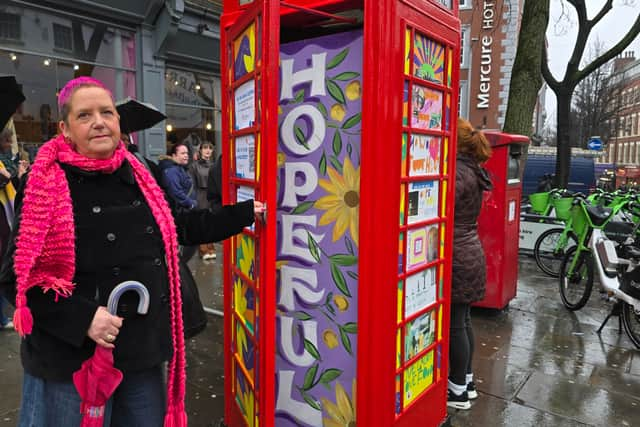
One of the most recent initiatives to tackle the soaring numbers of people rough sleeping is the conversion of an old, red phone box in Carlton Street, Hockley, into a resource point for the public and rough sleepers.
The phone box was opened on Monday (January 19) by homelessness charity Framework, and the city’s business improvement organisation; It’s in Nottingham.
It features a map showing the locations of a range of services from street kitchens, clothing and essentials to harm reduction and advice services.
It has been enveloped in artwork created by Framework service users, and opening the door reveals a “hopeful” message.
Framework’s head of fundraising and communications, Claire Eden, said: “People who come to Hockley will know very well you will see quite a few rough sleepers. Emmanuel House is at the bottom of the street, a lot of people pass this phone box.
“The point of the phone box is, if you’re a concerned member of the public you will know what to do, you will be able to see there are services for people, you will see the 0800 number here. So if you meet someone and you are concerned… you can ring that number and our street outreach team will come by and come and see them that day.
“On the back is a map and that shows you were all the services are in the city centre, also along with a QR code that tells you were you can get free food every day of the week.
“There are lots of people who are delivering services in the city centre and members of the public sometimes think nothing is happening, and nobody is doing anything. We are hoping members of the public and rough sleepers themselves can see people care.”
Residents of Framework’s Grove House, which provides accommodation for women previously sleeping on the streets, helped to create artwork for the windows in the phone box.
Kay Breach has been receiving help from Framework for 16 years, and has been in some form of care since she was 18.
“The first hostel I ever went to was Coalville, and then I’ve been in and out of the system ever since,” she said.
“I’m hoping this helps people out. It is getting a lot worse than it was 16 years ago. You see a lot more homeless people on the streets. There are people who don’t want to get help and are still on the streets, but there are those who do. It is hard for the outreach people to go and help them. That is the trickiest bit here.
“For 16 years before this hostel I have been trying to do loads of things and I couldn’t get them done. There was one particular support worker called Callum, and he has done everything for me in six months, all my money up and running and everything. Framework is a good help, just get the help you need and get a roof over your head, because it is not safe out. With everything going around, mamba, drugs, it is not safe.
“The reason why I did my art piece is because people have hidden talents and hidden disabilities, and they can still live their dream.”
Councillor Jay Hayes, the council’s executive member for housing, said that despite the rising numbers, “we’ve made some significant progress”.
The council said it had been “fire-fighting” in its housing services due to staffing problems, but a restructure of Housing Solutions – formerly Housing Aid – has helped.
The council received a combined £5 million in targeted funding via the Rough Sleeping Grant this year, which is being used to provide accommodation and support for rough sleepers and single homeless people.
This compliments its own £4.2m budget used to commission support services, including outreach and independent living support for single people and families.
To further combat the problem, the authority says a specialist team has been created within Housing Solutions to source private rented sector accommodation for people sleeping rough, providing incentives to landlords and support to the rough sleepers to help them overcome barriers to finding accommodation.
The team helped find tenancies for 193 individuals in 2024/25, and is on track to exceed this in 2025/26; having found 164 by the end of November 2025.
Specialist roles now also exist to support people leaving hospital and prison to avoid homelessness and ensure they have appropriate accommodation on release, with Nottingham having experienced a 38 per cent rise in prison referrals.