
Unassuming Nottinghamshire village where the UK’s biggest ever hoard of gold coins was found

The hoard contained more than 1,000 gold coins when it was found in 1966
If you fancy yourself as a bit of a history buff, the opportunities to further your hobby here in Nottinghamshire are endless.

Nottinghamshire is arguably one of the most historically significant counties in England, boasting dozens of nationally-recognised sites that provide an insight into our past.
Creswell Crags, for instance, provide evidence of human occupation in Nottinghamshire between 50,000 and 100,000 years ago - during the last Ice Age.
Other sites, such as Southwell Minster and Nottingham Castle - while by no means as old as Creswell Crags - remain invaluable to archaeologists and historians.
For as much as Nottinghamshire is packed with all kinds of historical sites above ground, you can be sure that plenty more remains undiscovered beneath ground.
All kinds of historical artefacts have been uncovered during excavations in Nottinghamshire over the years.
Whether during large-scale excavations or by amateur metal detectorists, some of these artefacts have gained international recognition.
Ask any historian the most impressive archaeological find in Nottinghamshire and you’ll probably receive one unanimous reply: The Fishpool Hoard.
The famous Fishpool Hoard unearthed in Ravenshead
Ask any historian the most impressive archaeological find in Nottinghamshire and you’ll probably receive one unanimous reply: The Fishpool Hoard.
The village of Ravenshead, near Sherwood Forest, became a scene of national attention in 1966 when builders unearthed what would become the largest hoard of medieval coins found in Britain.
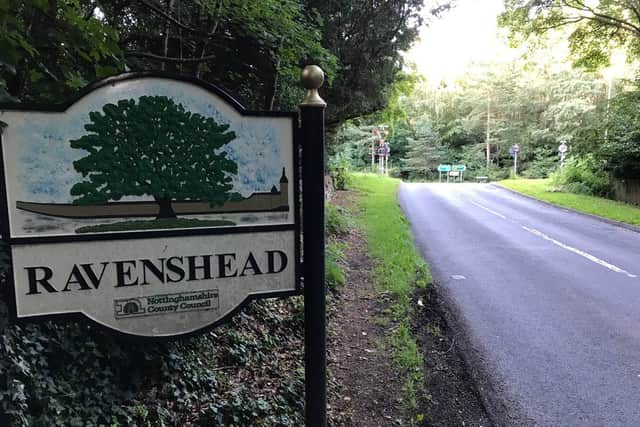
At the time of the discovery the area, known then as Fishpool, was under development to build new homes.
On the morning of March 22, 1966, builders working on new properties in Cambourne Gardens were carrying out excavations when they noticed a cluster of gold coins in a mechanical shovel.
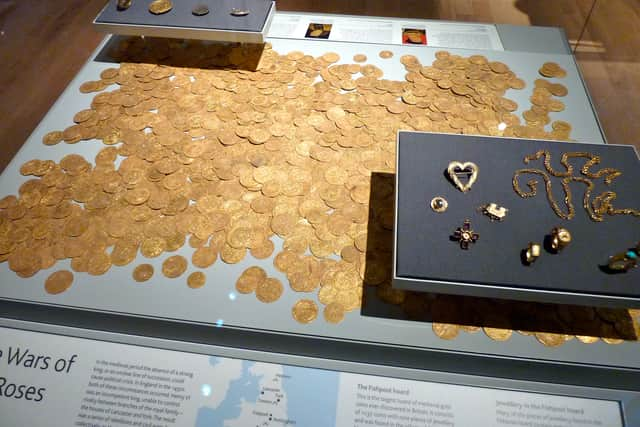
After the discovery was subsequently reported, a professional dig unearthed a staggering 1,237 15th century gold coins, four rings and four other pieces of jewellery, and two lengths of gold chain.
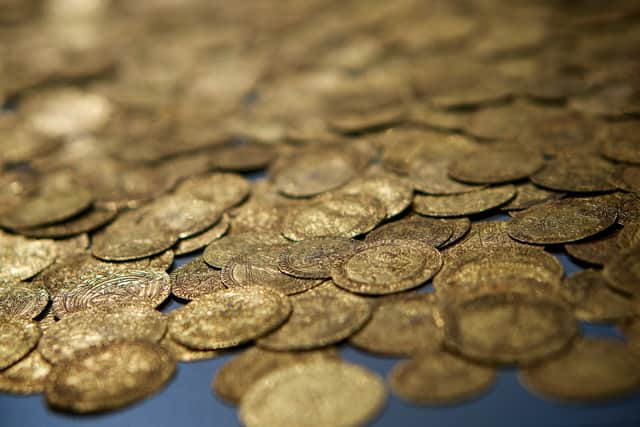
Historians believe that the hoard was probably buried in haste at some time between winter 1463 and summer 1464, perhaps by someone fleeing south after the Battle of Hexham in May 1464.
In 2003, the hoard was listed as one of the top 10 treasures ever found in Britain.