
Nottingham’s hidden connection with London’s iconic St Pancras station

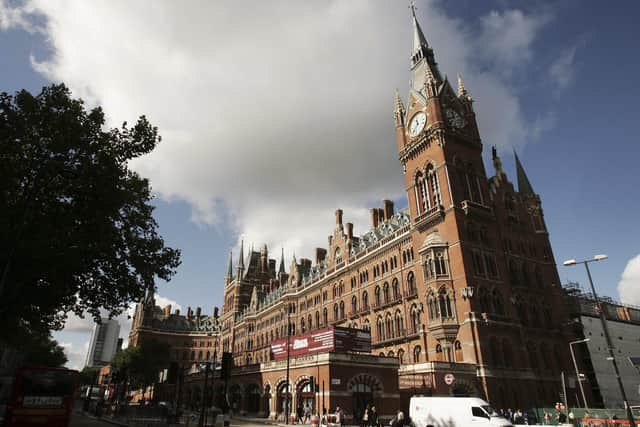
Next time you get off the train at London’s St Pancras station, take a moment to look up at its magnificent Euston Road frontage. Because just like you, that building - or, more precisely, the materials it is made from - once made the same trip down from Notts.
The bulk of the familiar red bricks and stone for that iconic building were sourced from Nottinghamshire. The iron is from just over the border in Derbyshire. Even the tiles are Midlanders - they came from Stoke-on-Trent.
When St Pancras opened for train travel in 1868 it represented a giant stride forward both for London and the Midlands.

To satisfy the Victorian zeal for progress, modernisation, and growth, greater connectivity of people and commerce around the country was essential.
The Midland Railway Company was an important player on the national transport scene, but prior to 1868, it did not operate a direct line to London. St Pancras changed that forever.
‘St Pancras hotel crafted in Midlands’
The first priority for the firm was to petition Parliament for the rights to operate the crucial direct line to London. With that secured, the new route had to be honoured with a grand new station, and a fittingly splendid hotel to open eight years later on the same site.
The delivery of that vision was as ambitious as it was symbolic. The bricks, stone and metal for the project would be sourced from the Midlands, and the new rail line would make the transport of the materials possible.
The main shed of the new St Pancras - covered by that unmistakable arched iron and glass roof - was completed in 1868. The hotel opened in 1876.
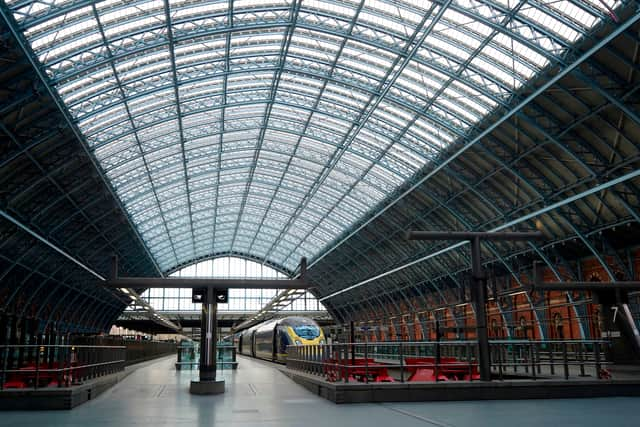
The design for the overall project was awarded to engineers William Henry Barlow and Rowland Mason Ordish, while the task of designing the separate but, arguably more eternally recognisable element, the hotel, was handed to architect Sir George Gilbert Scott.
Setting about constructing one of the finest examples of neo-Gothic architecture in Europe, Scott sought bricks and stone that would provide precisely the right shade of red.
Whether it was Scott’s initiative, or through the efforts of the Midland Railway Company, the finished building was made of the Midlands down to its bones. It was made of Mansfield red sandstone, Mapperley bricks, Butterley Iron from Derbyshire, and Minton Tiles from Stoke-on-Trent.
‘Historian’s passion revealed’
Uncovering the story of the construction of St Pancras, and its many midlands connections, has been the passion of local urban historian and writer Lucy Brouwer.
“Most building materials used to be sourced locally because of the difficulty in transporting it. This was a building made from bricks and stone brought in from the Midlands.
“It was as if the Midlands Railway Company wanted to say that they were going to show London a different way of doing things.
“It was a great example of gothic revival buildings, and the juxtaposition of the technical advances of the era with their looking back to the medieval period.”
As well as being a member of the Nottingham Civic Society, and a researcher and writer on art and architecture, Brouwer runs regular guided walking tours uncovering the story of Nottingham architect Watson Fothergill.
And therein lies another connection. As an apprentice architect working in London, Fothergill was inspired by the senior Gilbert Scott, and particularly the St Pancras hotel design.
It was a lifelong admiration he commemorated by placing a bust of Scott on his idiosyncratic George Street office, among the many architects to have shaped his vision.
“Scott was one of the pillars he looked up to,” says Brouwer.
Watson Fothergill buildings in Nottingham bear strikingly similar patterns and colours to the St Pancras hotel, and it’s very likely that many of them are made from the same Mapperley bricks and Mansfield red sandstone that was sent to London in the 1860s.
It was a historic project, and a big step forward, that connected Nottingham to London in more ways than one.